
Predictors of resting anorectal pressure changes after home-based biofeedback training combined with electrical stimulation in fecal incontinence: an exploratory retrospective analysis
Authors:
A. Lukáč 1,2
 ; Peter Lipták 1,2
; E. Baranovičová 3
; M. Piskorová 2; M. Schnierer 1,2
; P. Bánovčin 1,2
; Peter Lipták 1,2
; E. Baranovičová 3
; M. Piskorová 2; M. Schnierer 1,2
; P. Bánovčin 1,2
Authors place of work:
Clinic of Internal Medicine – Gastroenterology, University Hospital Martin
1; Jessenius Faculty of Medicine in Martin, Comenius University in Bratislava, Martin
2; Biomedical Centre Biomed Martin, Jessenius Faculty of Medicine, Comenius University in Bratislava, Martin
3
Published in the journal:
Gastroent Hepatol 2026; 80(4): 293-300
Category:
Klinická a experimentální gastroenterologie: původní práce
doi:
https://doi.org/10.48095/ccgh2026293
Summary
Background: Biofeedback combined with local electrical stimulation is an established conservative treatment for fecal incontinence and is used to restore voluntary control of the anal sphincter complex and the pelvic floor musculature. Despite generally favorable outcomes, the therapeutic response remains markedly heterogeneous, and data on predictors of manometric response to combined biofeedback and local electrical stimulation remain limited. Resting mean anal pressure (RMP) largely reflects the function of the internal anal sphincter, which is an involuntary smooth muscle component of the continence mechanism. Methods: We retrospectively analyzed a cohort of 48 adult women with chronic fecal incontinence refractory to conservative management, who completed a 12-week home-based program of biofeedback training combined with local anal electrical stimulation. Three-dimensional high-resolution anorectal manometry was performed before and after therapy in accordance with the IAPWG protocol. Manometric response was defined as a ≥ 20% increase in RMP from baseline. Baseline manometric parameters and patient age were evaluated as potential predictors using the Mann-Whitney U test and a cross-validated random forest algorithm with receiver operating characteristic curve analysis. Paired pre - and post-therapy comparisons were performed using the Wilcoxon signed--rank test, and Spearman correlation was used to assess the association between baseline RMP and its subsequent change. Results: 18 patients (37.5%) were classified as manometric responders and 30 (62.5%) as non-responders. Median age was 58.5 years (IQR 50.0–66.2). Manometric responders showed markedly lower baseline RMP than non-responders (27.5 vs. 53.1 mmHg, P < 0.001). Resting maximum pressure (32.0 vs. 65.3 mmHg, P < 0.001) and length of the high-pressure zone (3.3 vs. 4.0 cm, P = 0.002) also contributed substantially to prediction, while maximum voluntary squeeze pressure also differed between the groups (P = 0.020). Duration of maximum voluntary contraction (P = 0.377) and patient age (P = 0.798) did not differ significantly. The three-variable predictive model reached an AUC of 0.776 (95% CI 0.553–0.940). At the cohort level, RMP did not change significantly after therapy (P = 0.089), whereas resting maximum pressure (P = 0.009) and maximum voluntary squeeze pressure (P < 0.001) increased significantly. Baseline RMP was inversely correlated with both absolute (ρ = −0.336, P = 0.021) and relative (ρ = −0.457, P = 0.001) changes in RMP. Conclusion: In this exploratory analysis, baseline resting anorectal manometry parameters and the length of the high-pressure zone were the most informative predictors of manometric response to home-based biofeedback combined with local anal electrical stimulation, whereas patient age did not differ between manometric responders and non-responders. Although maximum voluntary squeeze pressure also differed between the groups, the addition of voluntary contraction parameters did not meaningfully improve model discrimination, and the association between lower baseline pressures and manometric response may be influenced by regression to the mean. These findings suggest that pretreatment manometric assessment may contribute to patient characterization; validation in prospective studies with parallel symptom-based and quality-of-life endpoints is needed.
Keywords:
fekálna inkontinencia – biofeedback – anorektálna manometria – elektrická stimulácia – análny sfinkter – prediktory
Introduction
Biofeedback combined with local electrical stimulation is an established conservative treatment for fecal incontinence and is used to restore voluntary control of the anal sphincter complex and the pelvic floor musculature [1]. The intervention combines targeted neuromuscular training with electrostimulation of the anal canal and could be used as a structured home--based program [2,3], although published data regarding this approach are scarce [4].
Despite generally favorable outcomes, the therapeutic response remains markedly heterogeneous and a substantial proportion of patients fail to achieve clinically meaningful improvement [3]. Previous attempts to identify reliable predictors of response have yielded inconsistent results – earlier cohort studies identified age and selected demographic factors as predictors of favorable response [5,6], whereas more recent analyses have not confirmed age or anorectal manometry parameters as independent predictors of symptomatic response [7]. Data on predictors of manometric response to combined biofeedback and local electrical stimulation, however, remain limited.
The present exploratory analysis focused specifically on resting mean anal pressure (RMP). RMP largely reflects the function of the internal anal sphincter, which is an involuntary smooth muscle component of the continence mechanism. Whether this voluntary contraction training combined with local electrical stimulation produces measurable changes in the involuntary sphincter component remains an open pathophysiological question.
Methods
We retrospectively analyzed a cohort of adult patients with chronic fecal incontinence refractory to conservative management, treated at the Clinic of Internal Medicine – Gastroenterology, University Hospital Martin. We included women aged ≥ 18 years with fecal incontinence (urge or passive) of at least 6 months duration and no prior history of surgery or injury in the anorectal region. Exclusion criteria were age < 18 years, inability to comply with the study protocol, fecal incontinence combined with constipation, previous anorectal surgery, known clinically relevant neurological disorder, and clinically significant hemorrhoidal disease.
Prior to enrollment in the home-based biofeedback program, all patients had received standard conservative management for fecal incontinence, including dietary and lifestyle modifications, stool consistency modification with fiber supplementation and/or loperamide. Patients were considered refractory to conservative management when significant symptoms persisted despite at least 6 months of such treatment. As the specific composition of prior conservative therapy was not systematically documented in the retrospective database, individual-level characterization was not possible; this has been acknowledged among the study limitations.
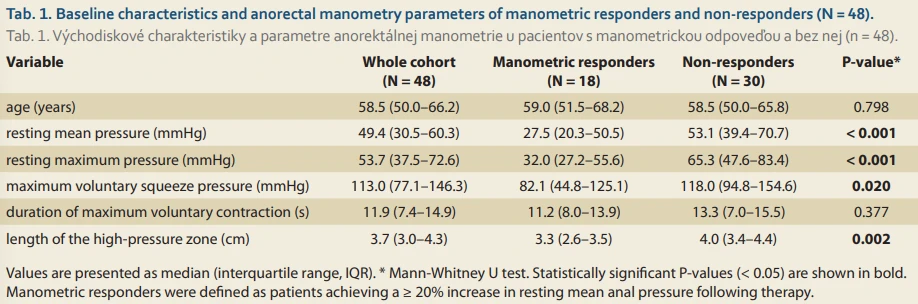
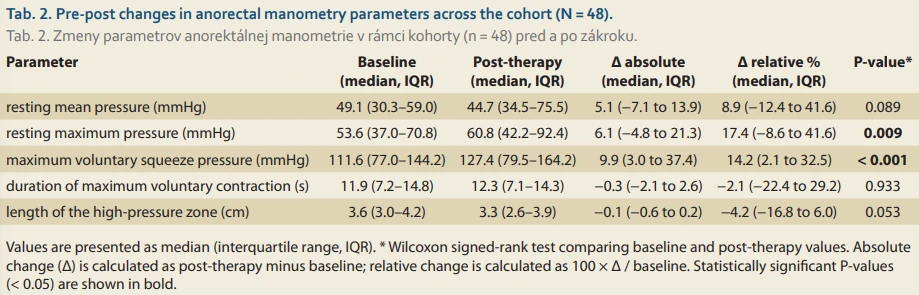
A total of 48 women completed the 12-week home-based program of biofeedback training combined with local anal electrical stimulation and were included in the analyses. Manometric response was defined as a ≥ 20% increase in resting mean anal pressure (RMP) from baseline. Baseline predictors of manometric response were evaluated in the full cohort (Tab. 1), and paired baseline and post-therapy comparisons of manometric parameters were performed in the same cohort (Tab. 2).
During the 12-week home-based program, patients were instructed to perform one session per day, each session lasting approximately 20 minutes and comprising the pre-programmed sequence of alternating voluntary contraction and electrical stimulation phases as described above. Patients were instructed to set the stimulation intensity themselves within a range chosen empirically based on prior clinical experience and available literature (up to a maximum of 25 mA), with the goal of achieving a clearly perceptible but non-painful stimulation. Written instructions were provided to all patients, and initial training on device operation was performed in the outpatient clinic.
Adherence to the home program was based on patient self-report. Control 3D HRAM was performed at 12 weeks (± 3 days) after initiation of the program in all patients. Both baseline and control HRAM were performed and analyzed by a single experienced examiner without blinding with respect to the time point (baseline vs. post-therapy) or responder status.
Three-dimensional high-resolution anorectal manometry (3D HRAM) was performed before initiation and at completion of the therapeutic cycle in accordance with the IAPWG protocol [8].
The primary outcome was the manometric change in resting mean pressure (RMP) after therapy; patients were classified as manometric responders when they achieved a ≥ 20% increase in RMP from baseline. The following baseline parameters were concurrently evaluated as potential correlates of manometric response: resting maximum pressure, length of the high-pressure zone (HPZ), maximum voluntary squeeze pressure, duration of maximum voluntary contraction, and patient age.
The ≥ 20% increase in RMP was used as the definition of manometric response. This threshold was empirically chosen based on prior clinical experience and available literature on manometric response to biofeedback and electrical stimulation, as no consensus threshold for manometric response has been established. To address the influence of this relative threshold on the interpretation of results, RMP change was also analyzed as a continuous variable.
In addition to the binary classification of manometric responders and non-responders, the absolute (DRMP = RMPpost − – RMPbaseline) and relative (DRMP% == 100 × DRMP / RMPbaseline) changes in RMP were calculated for each patient. Spearman correlation was used to assess the association between baseline RMP and the magnitude of RMP change, in order to evaluate the extent to which the observed responder–non-responder pattern may reflect a regression-to-the-mean effect.
Descriptive between-group comparisons of continuous variables were performed using the non-parametric Mann-Whitney U test for the null hypothesis of equality of medians; results are summarized as median (interquartile range, IQR) in Tab. 1. Paired comparisons of baseline and post-therapy manometric parameters were performed using the Wilcoxon signed-rank test and are summarized in Tab. 2.
Predictive modeling was performed using a cross-validated random forest algorithm. The relationships between baseline continuous variables were assessed by Pearson and Spearman correlation analyses, and categorical variables were compared with the Chi-square (c²) test of independence. The predictive contribution of individual baseline parameters and the discriminative performance of sequentially built predictive models were evaluated by receiver operating characteristic (ROC) curve analysis, with calculation of the area under the curve (AUC) and corresponding 95% confidence intervals.
Two-sided P-values below 0.05 were considered statistically significant. Analyses were performed in OriginPro 2026 (Academic license; OriginLab Corporation, Northampton, MA, USA) and on the MetaboAnalyst online platform.
Results
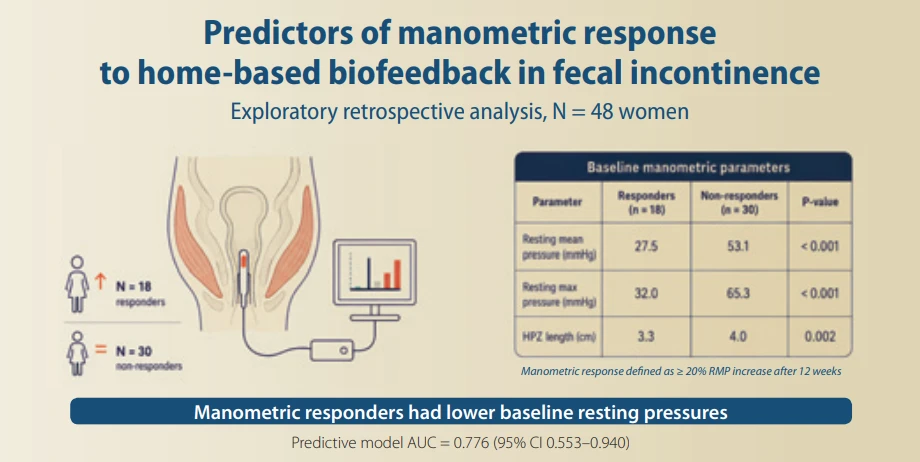
The primary endpoint, defined as a ≥ 20% increase in resting mean anal pressure (RMP) following therapy, was reached by 18 patients (37.5%), who were classified as manometric responders; the remaining 30 patients (62.5%) constituted the non-responder group. The median age of the cohort was 58.5 years (interquartile range, IQR 50.0–66.2). All patients were female, in accordance with the inclusion criteria. The cohort included both urge and passive incontinence phenotypes.
Pre-post changes in manometric parameters across the cohort are summarized in Tab. 2. Resting mean anal pressure did not change significantly at the cohort level after 12 weeks of home--based biofeedback combined with local anal electrical stimulation (from a median baseline of 49.1 mmHg to 44.7 mmHg post-therapy; median absolute change +5.1 mmHg, IQR −7.1 to +13.9; median relative change +8.9%, IQR −12.4 to +41.6; Wilcoxon signed-rank test P = 0.089). By contrast, resting maximum pressure showed a significant increase (P = 0.009) and maximum voluntary squeeze pressure showed a marked increase (P < 0.001), while the length of the high-pressure zone tended toward a small decrease (P = 0.053) and the duration of maximum voluntary contraction did not change (P = 0.933).
When analyzed as a continuous variable, the absolute RMP change showed a significant negative correlation with baseline RMP (Spearman ρ = −0.336, P = 0.021), and the relative RMP change showed an even stronger inverse association with baseline RMP (ρ = −0.457, P = 0.001). Patients with lower baseline pressures thus exhibited larger absolute and relative increases in RMP. A negative correlation between baseline values and subsequent change is compatible with a regression-to-the-mean effect and should be considered when interpreting the higher response rate observed in patients with lower baseline pressures.
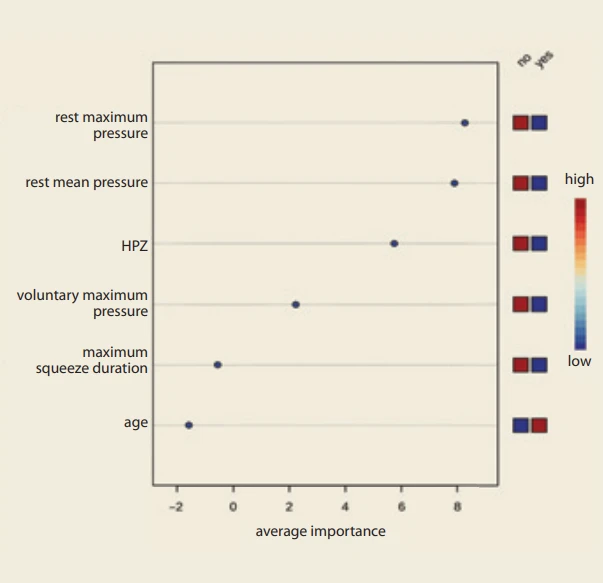
Baseline anorectal manometry parameters of manometric responders and non-responders are summarized in Tab. 1. Although resting mean pressure (RMP) was used to define manometric response, baseline RMP was also one of the strongest predictors of this response, with manometric responders showing markedly lower baseline RMP values than non-responders (27.5 mmHg, IQR 20.3–50.5 vs. 53.1 mmHg, IQR 39.4–70.7; P < 0.001) (Graph 1). Patients with more advanced manometric impairment of resting sphincter function showed a greater manometric change following combined biofeedback and local anal electrical stimulation; however, this association should be interpreted with caution given the methodological considerations discussed below. Consistent with this finding, resting maximum pressure (32.0 mmHg, IQR 27.2–55.6 vs. 65.3 mmHg, IQR 47.6–83.4; P < 0.001) and length of the high-pressure zone (3.3 cm, IQR 2.6–3.5 vs. 4.0 cm, IQR 3.4–4.4; P = 0.002) also contributed substantially to prediction, while maximum voluntary squeeze pressure also differed between the groups (82.1 mmHg, IQR 44.8–125.1 vs. 118.0 mmHg, IQR 94.8–154.6; P = 0.020). Duration of maximum voluntary contraction (P = 0.377) and patient age (P = 0.798) did not differ significantly between manometric responders and non-responders (Graph 1).
As expected, baseline resting mean pressure and resting maximum pressure were strongly correlated (Pearson r = 0.97, Spearman ρ = 0.99; both P < 0.001), reflecting overlap in their description of resting anal sphincter function. This co-linearity between the two strongest predictors was accounted for in the predictive modelling by the cross-validated random forest algorithm, which ranks variable importance and does not double-count highly correlated features.
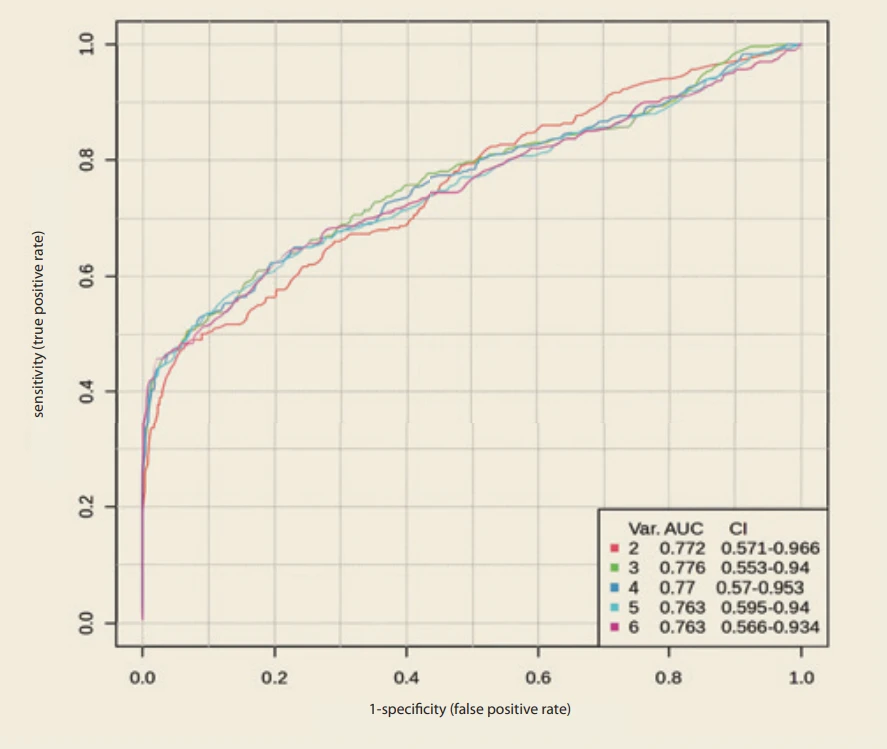
The discriminative performance of the predictive model incorporating the resting manometric parameters reached an AUC of 0.776 (95% CI 0.553–0.940). The addition of voluntary contraction parameters and patient age did not meaningfully improve model performance (Graph 2).
Discussion
The principal finding of this exploratory analysis is that baseline resting anorectal manometry parameters and the length of the high-pressure zone were more informative predictors of manometric response than patient age or parameters of voluntary contraction. Manometric response was defined as a ≥ 20% increase in resting mean anal pressure following therapy. Manometric responders showed lower -baseline resting pressures and a shorter HPZ, indicating more advanced functional impairment of the sphincter complex.
At the whole-cohort level, resting mean anal pressure did not increase significantly after therapy, whereas resting maximum pressure and maximum voluntary squeeze pressure showed significant increases. This pattern suggests that the intervention primarily affected voluntary sphincter function and peak resting pressure, whereas the average resting pressure of the whole cohort did not change significantly. Individual RMP trajectories were nonetheless heterogeneous, with a substantial proportion of patients showing clear increases (i.e., manometric responders) and others showing decreases or stable values.
Patients with lower baseline resting pressures showed a higher likelihood of meeting the manometric response criterion. Several non-exclusive explanations for this observation should be considered. One possibility is a genuine physiological effect, in which patients with greater room for improvement respond more markedly to combined biofeedback and electrical stimulation, consistent with the concept of physiological reserve. However, our continuous analyses demonstrate a significant inverse correlation between baseline RMP and both absolute (ρ = −0.336, P = 0.021) and relative (ρ = −0.457, P = 0.001) changes in RMP. Such an inverse relationship is typical of regression to the mean, a well-known statistical phenomenon in repeated physiological measurements with inherent test-retest variability. Regression to the mean, together with the fact that a relative threshold of ≥ 20% mathematically requires a smaller absolute increase in patients with lower baseline pressures, may therefore substantially explain the observed responder pattern. The association between lower baseline pressures and manometric response should thus be interpreted with caution and cannot be attributed to physiological reserve alone.
Previous cohort studies have reported inconsistent findings regarding the role of age [5,7]. In our cohort, patient age did not differ between manometric responders and non-responders, consistent with the most recent evidence [7].
Our findings suggest that pretreatment manometric assessment may help identify patients who are more likely to show a manometric response to biofeedback combined with local anal electrical stimulation. Whether this manometric response translates into clinical benefit needs to be established in prospective studies incorporating parallel symptom-based and quality-of-life outcomes. The present analysis provides an exclusively mechanistic perspective on treatment response, relying on manometric changes in anal pressure without parallel assessment of clinical symptomatology. Other limitations include a small, single-center sample, the clinical heterogeneity of the cohort with respect to fecal incontinence phenotype and baseline anorectal physiology, and the retrospective, uncontrolled design which limited the systematic characterization of prior conservative therapy at the individual level, did not allow blinded evaluation of manometric recordings with respect to the time point of assessment or responder status, and made it impossible to separate the effects of the intervention from natural variability of repeated manometric measurements or other time--dependent factors. Because no objective adherence monitoring was in place, we can confirm only that patients attended the control assessment, not that they adhered to daily home training throughout the 12-week program. The present study was designed to evaluate predictors of manometric response to home-based biofeedback combined with local anal electrical stimulation as an intervention category. A comparison of specific device configurations was therefore not within the scope of this analysis, and the reported findings should be interpreted as pertaining to the overall intervention approach. There is also the methodological consideration that a relative threshold of ≥ 20% increase in RMP mathematically favors patients with lower baseline values. In addition, the confirmed inverse correlation between baseline RMP and its subsequent change is consistent with a regression-to-the-mean effect and should be considered when interpreting the causal significance of this finding. Despite these limitations, the present cohort reflects everyday clinical practice and provides real-world data on predictors of manometric response to combined biofeedback and local electrical stimulation, for which published data are still limited.
Conclusion
In this exploratory analysis, baseline resting anorectal manometry parameters and the length of the high-pressure zone were the most informative predictors of manometric response to biofeedback combined with local anal electrical stimulation. Manometric response was defined as a ≥ 20% increase in resting mean anal pressure from baseline. Patient age did not differ between manometric responders and non-responders. Although maximum voluntary squeeze pressure differed between the groups, the addition of voluntary contraction parameters did not meaningfully improve the discriminative performance of the predictive model over baseline resting pressure parameters. However, the observed association between lower baseline pressures and manometric response may be substantially influenced by regression to the mean and by the mathematical properties of the relative response threshold. These findings suggest that pretreatment manometric assessment may contribute to patient characterization; however, whether it can meaningfully inform patient selection and whether the observed manometric changes translate into clinical benefit requires validation in prospective studies incorporating parallel symptom-based and quality-of-life endpoints.
Submitted/Doručené: 16. 6. 2026
Accepted/Prijaté: 6. 8. 2026
Corresponding author
Adam Lukáč, MD
Clinic of Internal Medicine –Gastroenterology
Jessenius Faculty of Medicine in Martin Comenius University in Bratislava,University Hospital Martin
Kollárova St. 4248/2
036 59 Martin
lukac.adam.99@gmail.com
Zdroje
1. Vonthein R, Heimerl T, Schwandner T et al. Electrical stimulation and biofeedback for the treatment of fecal incontinence: a systematic review. Int J Colorectal Dis 2013; 28 (11): 1567–1577. doi: 10.1007/s00384-013-1739-0.
2. Rao SS, Benninga MA, Bharucha AE et al. ANMS-ESNM position paper and consensus guidelines on biofeedback therapy for anorectal disorders. Neurogastroenterol Motil 2015; 27 (5): 594–609. doi: 10.1111/nmo.12520.
3. Norton C, Cody JD. Biofeedback and/or sphincter exercises for the treatment of faecal incontinence in adults. Cochrane Database Syst Rev 2012; (7): CD002111. doi: 10.1002/14651858.CD002111.pub3.
4. Lipták P, Lukáč A, Mikler J et al. Home-based biofeedback with local anal electrical stimulation for fecal incontinence in women without sphincter structural defects. Front Med 2026; 13 : 1835226. doi: 10.3389/fmed.2026.1835226.
5. Fernández-Fraga X, Azpiroz F, Aparici A et al. Predictors of response to biofeedback treatment in anal incontinence. Dis Colon Rectum 2003; 46 (9): 1218–1225. doi: 10.1007/s10350-004-6718-7.
6. Byrne CM, Solomon MJ, Young JM et al. Biofeedback for fecal incontinence: short-term outcomes of 513 consecutive patients and predictors of successful treatment. Dis Colon Rectum 2007; 50 (4): 417–427. doi: 10.1007/s10 350-006-0846-1.
7. Mazor Y, Prott G, Jones M et al. Factors associated with response to anorectal biofeedback therapy in patients with fecal incontinence. Clin Gastroenterol Hepatol 2021; 19 (3): 492–502. doi: 10.1016/j.cgh.2020.03.050.
8. Carrington EV, Heinrich H, Knowles CH et al. The international anorectal physiology working group (IAPWG) recommendations: Standardized testing protocol and the London classification for disorders of anorectal function. Neurogastroenterol Motil 2020; 32 (1): e13679. doi: 10.1111/nmo.13679.
Štítky
Detská gastroenterológia Gastroenterológia a hepatológia Chirurgia všeobecnáČlánok vyšiel v časopise
Gastroenterologie a hepatologie

2026 Číslo 4
- Těhotenství a idiopatické střevní záněty – terapie zlepšuje stav a je bezpečná
- Vliv těhotenství na klinickou aktivitu Crohnovy nemoci
- Medikace u IBD v těhotenství
- Adherence a kvalita života adolescentních pacientů s IBD
- Adherence pacientů se střevním zánětlivým onemocněním
Najčítanejšie v tomto čísle
- Selecting the right probiotic: from strain specificity to rational clinical application
- Klinická a experimentální gastroenterologie
- Severe upadacitinib-induced anemia in a multi-refractory Crohn’s disease patient – a case report
- Predictors of resting anorectal pressure changes after home-based biofeedback training combined with electrical stimulation in fecal incontinence: an exploratory retrospective analysis