
Sporadic cerebellar hemangioblastomas and the role of cyst size in surgical outcomes – a single-surgeon experience from a single center
Sporadické cerebelární hemangioblastomy a úloha velikosti cysty v chirurgických výsledcích – zkušenosti jednoho chirurga z jednoho centra
Cíl: Hemangioblastomy jsou benigní, vysoce vaskulární nádory, které vznikají v centrálním nervovém systému. Histologicky jsou tyto nádory tvořeny stromálními buňkami zabudovanými do husté sítě cév. Cílem této studie bylo zhodnotit naše výsledky operací u sporadických cerebelárních hemangioblastomů a analyzovat vztah mezi velikostí cystické složky a výskytem hydrocefalu a souvisejících neurologických příznaků. Soubor a metodika: Retrospektivně jsme analyzovali 29 dospělých pacientů se sporadickými cerebelárními hemangioblastomy operovaných jedním neurochirurgem mezi lety 2010 a 2022. Nádory byly rozděleny na solidní, malé cystické (< 2,5 cm) a velké cystické (≥ 2,5 cm). Hodnocena byla klinická data, nálezy na zobrazení a chirurgická data a výsledný funkční stav hodnocený pomocí skóre modifikované Rankinovy škály (mRS) a Karnofského skóre (KPS). Byla také zkoumána souvislost mezi velikostí cysty, hydrocefalem a neurologickým výsledkem. Výsledky: Větší cysty byly významně spojeny s výskytem hydrocefalu (p = 0,038) a mozečkovými symptomy (p = 0,026). Regresní analýza ukázala možnou souvislost mezi velikostí cysty a těmito nálezy (p = 0,062 a p = 0,053). Velikost cyst a uzlin vykazovaly středně silnou korelaci (r = 0,520; p = 0,013). U pacientů s nutnou zevní komorovou drenáží byla průměrná velikost cysty větší (41,00 vs. 28,78 mm; p = 0,053). Ve skóre mRS nebo KPS před operací a za 1 rok po operaci nebyly mezi skupinami zjištěny významné rozdíly (p > 0,6). Závěr: Hemangioblastomy jsou benigní, ale jejich umístění v zadní jámě lební často způsobuje závažné příznaky. Nejlepší léčbou zůstává en bloc resekce uzlu s rozsáhlou kraniotomií. Tato studie zdůrazňuje souvislost mezi velkými cystami a hydrocefalem a naznačuje, že včasný chirurgický zákrok může zlepšit výsledky léčby.
Klíčová slova:
cysta – hydrocefalus – hemangioblastom – zadní jáma lební
Authors:
O. Altunyuva 1; N. Balcin 1; A. I. Ozmarasali 1; O. Balcin 2; S. Yilmazlar 1
Authors‘ workplace:
Department of Neurosurgery, Bursa Uludag University School of Medicine, Bursa, Turkey
1; Department of Biostatistics, Bursa Uludag University School of Medicine, Bursa, Turkey
2
Published in:
Cesk Slov Neurol N 2025; 88(6): 357-364
Category:
Original Paper
doi:
https://doi.org/10.48095/cccsnn2025357
Overview
Aim: Hemangioblastomas are benign, highly vascular tumors that originate within the central nervous system. Histologically, these tumors are composed of stromal cells embedded in a dense network of blood vessels. The aim of the study was to present our surgical outcomes in sporadic cerebellar hemangioblastomas and to investigate the relationship between the cystic component size and the presence of hydrocephalus and associated clinical findings. Materials and methods: We retrospectively reviewed 29 adult patients with sporadic cerebellar hemangioblastomas operated by a single surgeon between 2010 and 2022. Tumors were classified as solid, small cystic (< 2.5 cm), or large cystic (≥ 2.5 cm). Clinical, imaging, and surgical data were analyzed, and functional outcomes were measured using the modified Rankin Scale (mRS) and Karnofsky Performance Scale (KPS) scores. The relationship between cyst size, hydrocephalus, and neurological outcome was also examined. Results: Larger cysts were significantly linked to hydrocephalus (P = 0.038) and cerebellar symptoms (P = 0.026). Regression suggested a possible association between cyst size and these findings (P = 0.062 and P = 0.053). Cyst and nodule sizes showed moderate correlation (r = 0.520; P = 0.013). Cysts were also larger in patients needing an external ventricular drain (41,00 vs. 28,78 mm; P = 0.053). No significant differences were found between groups in mRS or KPS scores before and 1 year after surgery (P > 0.6). Conclusion: Hemangioblastomas are benign, but their posterior fossa location often causes significant symptoms. En bloc resection of the nodule with wide craniotomy remains the best treatment. This study highlights the link between large cysts and hydrocephalus, suggesting early surgery may improve outcomes.
Keywords:
cyst – hydrocephalus – hemangioblastoma – posterior fossa
Introduction
Hemangioblastomas are benign, highly vascular tumors that originate within the central nervous system [1–6]. Histologically, these tumors are composed of stromal cells embedded in a dense network of blood vessels [1]. They represent the most common benign extra-axial tumors of the posterior fossa in adults, accounting for approximately 2% of all intracranial tumors and 7–12% of posterior fossa tumors [1–3,7]. Within the posterior fossa, the cerebellar hemispheres are the most frequently affected sites [3,5,8]. Outside the posterior fossa, the spinal cord represents the second most frequent location for hemangioblastomas in the central nervous system [5,9], while supratentorial localization is rare [1,2].
Hemangioblastomas are typically sporadic tumors; however, some cases are associated with Von Hippel–Lindau (VHL) disease [1–4,10–13]. Macroscopically, these tumors consist of two components: cystic and solid [2]. Clinical presentation varies depending on their location within the central nervous system, with posterior fossa lesions typically manifesting with increased intracranial pressure-related symptoms and cerebellar signs [1,3,14]. MRI is the gold standard for the radiological diagnosis of hemangioblastomas [1,3]. Following gadolinium administration, the solid components exhibit homogeneous enhancement, while the cystic portions demonstrate peripheral enhancement due to the tumor’s hypervascular nature [3]. According to the literature, three distinct radiological patterns have been described: solid, solid/cystic, and mural nodule cystic types [15]. Gross total resection remains the optimal surgical approach for hemangioblastomas [15,16], while radiosurgery may be considered for small or residual lesions [2].
In this study, we retrospectively reviewed cases of sporadic cerebellar hemangioblastomas that underwent surgical treatment at our institution. The aim of the study was to present our surgical outcomes in the context of existing literature and to investigate the relationship between the cystic component – an aspect that has not been previously evaluated in the literature with respect to radiological and clinical features – and the presence of hydrocephalus and associated clinical findings.
Materials and methods
Twenty-nine adult patients with sporadic cerebellar hemangioblastomas who underwent surgery performed by a single surgeon (SY) at the Department of Neurosurgery, Bursa Uludag University School of Medicine, Bursa, Turkey, between November 2010 and October 2022 were retrospectively reviewed. Data were collected regarding presenting symptoms, clinical findings, radiological evaluations, surgical techniques, complications, pathological results, and neoadjuvant treatment protocols.
Patients were categorized into three groups based on the radiological characteristics of the tumor: Group 1 included cases with isolated solid components; Group 2 included tumors with cystic components measuring less than 2.5 cm; and Group 3 included tumors with cystic components measuring 2.5 cm or larger. All patients underwent preoperative cranial contrast-enhanced MRI.
Nodular and cystic components, presence of hydrocephalus, and need for additional cranial procedures were analyzed. Preoperative and postoperative modified Rankin Scale (mRS) scores and Karnofsky Performance Status (KPS) scores were evaluated. Long-term survival, the need for further surgical intervention, postoperative complications, and changes in neurological status were also assessed.
Normality was assessed using the Shapiro-Wilk test, and homogeneity of variances with Levene’s test. Chi-square or Fisher-Freeman-Halton tests were used for categorical data. Continuous variables were compared with the t-test or Mann-Whitney U test. Logistic regression, Kruskal-Wallis, and Spearman’s correlation analyses were also performed when appropriate.
Results
The study included 29 patients (17 males, 12 females; mean age: 40.34 ± 13.34 years). Tumors were located in the cerebellar hemispheres in 24 cases (82.8%) and in the vermis or tonsils in five (17.2%). A cystic component was present in 22 patients (75.9%), while seven (24.1%) had solid tumors (Group 1). Among the cystic cases, nine had cysts < 2.5 cm (Group 2) and 13 had cysts ≥ 2.5 cm (Group 3). Mean nodule sizes were 20 ± 5.42 mm (Group 1), 17.56 ± 3.32 mm (Group 2), and 17.23 ± 4.67 mm (Group 3) with no significant differences (P > 0.5). Mean cyst size was 20.33 ± 3.2 mm in Group 2 and 38.31 ± 9.21 mm in Group 3.
Headache was the most common symptom (79.3%), followed by cerebellar findings (41.4%). Mean symptom duration was 6.89 ± 9.8 months, and follow-up averaged 85.41 ± 39.92 months. Hydrocephalus was present in 37.9% at diagnosis (Tab. 1). Gross total resection was achieved in all but one case (3.45%), who underwent adjuvant stereotactic radiosurgery. External ventricular drain (EVD) was placed in four patients (30.8%) with cysts > 25 mm; none required permanent cerebrospinal fluid (CSF) shunts. Two patients (6.9%) underwent reoperations for hematoma; one (3.4%) for a CSF fistula. Intraventricular hematoma occurred in one case (3.4%), requiring EVD. This patient died from septic pneumonia in the early postoperative period (Tab. 2).
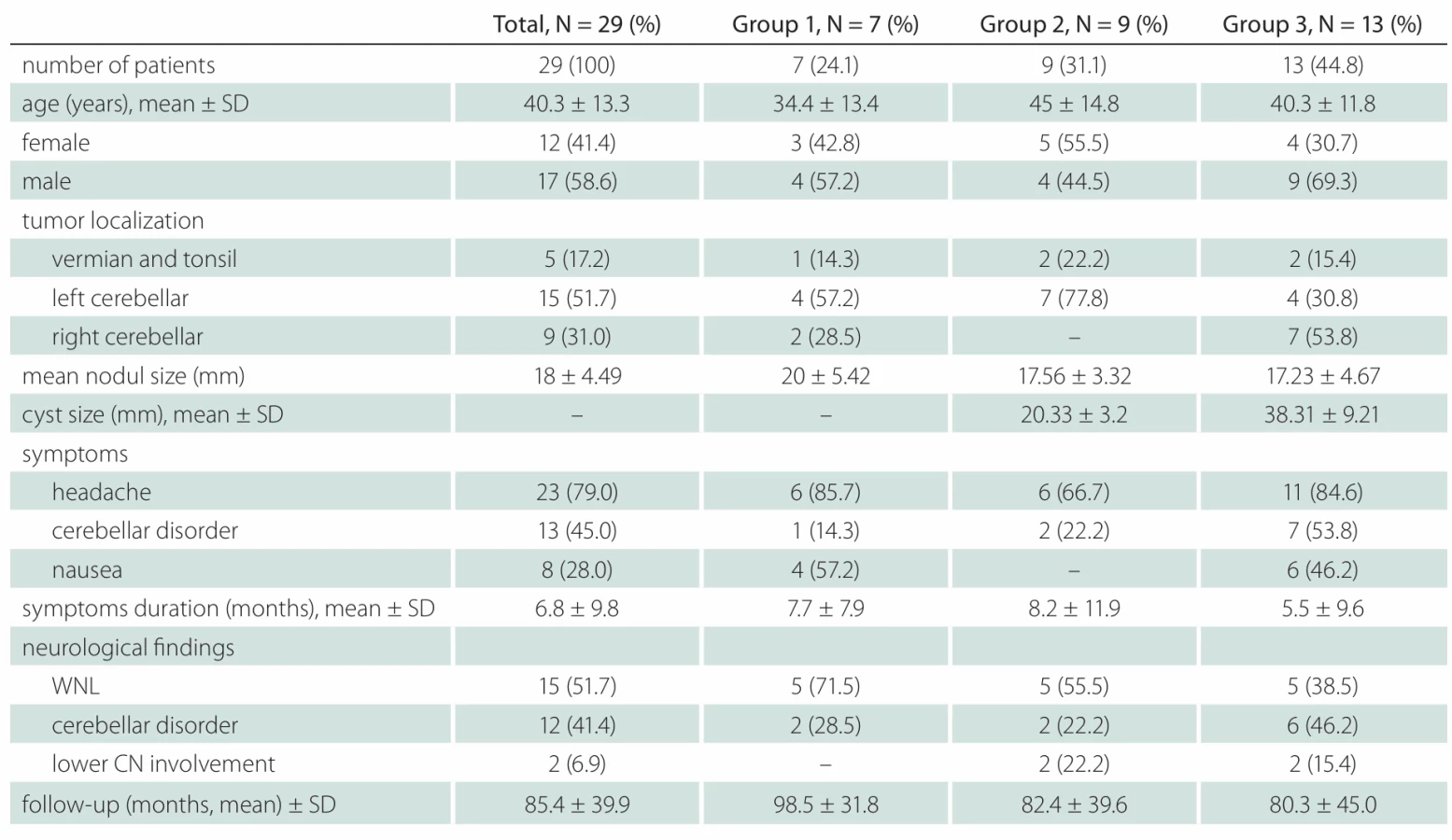
CN – cranial nerve; N – number; SD – standard deviation; WNL – within normal limits

CSF – cerebrospinal fl uid; EVD – external ventricular drainage; N – number
Statistical analysis
Despite limited sample size, standardization was ensured by analyzing a single-surgeon series. Independent samples t-test showed that cyst size was significantly associated with hydrocephalus (P = 0.038), with logistic regression indicating a trend-level increase in risk per mm enlargement (Exp (B) = 1.111, 95% CI: 0.995–1.240; P = 0.062). Patients with cerebellar symptoms had larger cysts (P = 0.026), and regression suggested a near-significant relationship between cyst size and symptom presence (Exp (B) = 1.122; P = 0.053). A moderate positive correlation was found between cyst and nodule size (r = 0.520; P = 0.013). Mean cyst size was also greater in patients requiring EVD (41.00 vs. 28.78 mm; P = 0.053). Surgical outcomes showed no significant differences between groups in pre - and 1-year postoperative KPS or mRS scores (P = 0.660 and P = 0.689) (Tab. 2). Symptom duration, headache, and cerebellar findings also did not differ significantly across groups (P = 0.294, P = 0.116, and P = 0.053, respectively).
Discussion
In this study, we aimed to review the current literature on hemangioblastomas, discuss it with our clinical results, introduce new perspectives to clinicians, and present our recommendations.
Von Hippel–Lindau disease
Although hemangioblastomas are typically sporadic tumors, they are associated with VHL disease in approximately 30–35% of cases [5,17,18]. VHL is an autosomal dominant disorder caused by a mutation in a tumor suppressor gene located at 3p25–26 on the short arm of chromosome 3 [2,7,10]. In affected individuals, new lesions develop on average every 2.1 years [4]. Therefore, patients require close radiological surveillance [8], and multiple surgical interventions are often necessary over time [10,19].
Pathogenesis
Microscopically, hemangioblastomas are composed of a vascular network surrounded by an endothelial layer and reticulin fibers [2]. In patients with VHL, mutations on chromosome 3 lead to overproduction of hypoxia-inducible factor 1-alpha (HIF-1a) and angiogenic factors such as vascular endothelial growth factor (VEGF) and transforming growth factor alpha (TGF-a). These angiogenic products contribute to the formation of the tumor’s hypervascular component [2]. The pathophysiological mechanism in which the cystic fluid – xanthochromic and plasma-like – is formed due to VEGF-induced hypervascular permeability, a result of intramedullary hematopoiesis commonly seen in hemangioblastomas [20].
Macroscopically, the cystic content of hemangioblastomas – particularly those with both cystic and solid components – appears yellowish due to the high protein concentration, which results from fluid leakage from fragile and irregular tumor vessels [2]. In general, the vascular supply of posterior fossa hemangioblastomas originates from the meningeal branches, as well as the superior cerebellar artery, anterior inferior cerebellar artery, and posterior inferior cerebellar artery [21]. The marked hypervascularity of these tumors poses challenges during surgery and increases the risk of complications such as postoperative bleeding at the resection site [6].
Surgery
Gross total resection is the preferred surgical approach for the treatment of hemangioblastomas [16]. Various surgical techniques can be employed depending on the location of posterior fossa hemangioblastomas [7,22,23]. In our series, the surgical approach was determined based on the tumor‘s location within the cerebellum. Specifically, hemangioblastomas were located in the right cerebellar hemisphere in nine patients (31%), the left cerebellar hemisphere in 15 patients (51.7%), and the midline structures – such as the cerebellar vermis and tonsils – in 5 patients (17.2%). This distribution is consistent with existing literature, which reports cerebellar hemispheres as the most common site [22].
A wide craniotomy provided better control of the cystic component and improved intraoperative bleeding management (Fig. 1). Furthermore, by initiating resection within the cyst and proceeding with coagulation from the periphery of the nodule to achieve devascularization, it facilitated the en bloc resection of the nodule with clear microsurgical margins, minimizing the risk of massive bleeding from the cyst walls. The critical point here is to avoid direct coagulation of the nodule before it has been devascularized. Therefore, we believe that performing a wide craniotomy to ensure full control of the cyst boundaries and to allow peripheral coagulation of the nodule‘s feeding arteries offers a significant surgical advantage in hemangioblastoma cases.

However, due to the rich vascular supply of hemangioblastomas, surgeons must be vigilant regarding the risk of postoperative hemorrhage in the resection area (Fig. 2). We recommend early postoperative monitoring in neurointensive care units (ICU), including carefully timed early extubation following short observation in the ICU, frequent neurological assessments, early cranial CT imaging, and careful management of systolic blood pressure to ensure adequate cerebral perfusion without promoting hemorrhagic complications.

In patients with symptomatic obstructive hydrocephalus caused by a large cystic component, particularly when there is marked brainstem compression, we place a temporary EVD intraoperatively after opening the dura and before tumor removal. This provides controlled decompression and helps maintain stable intracranial pressure during the procedure. The drain is kept in place for short-term monitoring and drainage in the early postoperative period, and is usually removed within 48–72 h once ventricular size has returned to baseline and the patient’s neurological status remains stable.
Radiosurgery
While radical en bloc resection of the nodule remains the primary treatment for hemangioblastomas, stereotactic radiosurgery can be effective in stabilizing small-sized or residual tumors [24,25]. In our series, only one patient underwent stereotactic radiosurgery due to a residual tumor identified in the postoperative period. Although stereotactic radiosurgery may be a viable option for patients with VHL who are under close radiological surveillance and experience frequent recurrences, we advocate for surgical intervention as the first-line treatment in cases of sporadic cerebellar hemangioblastoma. We particularly recommend prioritizing en bloc resection of the nodule for tumors with cystic components, as these are associated with an increased risk of cerebellar edema, herniation, and hydrocephalus [14,22,26].
Future directions
Gross total resection remains the standard treatment for hemangioblastomas, whereas radiosurgery may be considered in cases of subtotal resection or tumor recurrence [2,15,16,24]. However, emerging anti-angiogenic therapies targeting tumor development and cystic component formation hold promising potential [6]. In particular, agents such as VEGF inhibitors [27], somatostatin analogs that promote tumor apoptosis [28], and immunotherapeutic agents such as bevacizumab [29] may contribute to future therapeutic strategies. Additionally, compounds such as ICI-118,551 and PT2385, which exhibit both anti-angiogenic effects and the ability to disrupt tumor metastasis [30], could further reshape treatment protocols. Recently, belzutifan, a hypoxia-inducible factor-2a (HIF-2a) inhibitor, has received Food and Drug Administration (FDA) approval for the treatment of VHL disease - -associated tumors, including hemangioblastomas, representing a promising novel systemic therapy option [31,32]. Additionaly, novel brachytherapy techniques, such as GammaTile, have also shown promise in improving local tumor control while minimizing the risk of radiation necrosis [33].
Neurological findings
In our study, the most frequently reported presenting symptom was headache, observed in 22 patients (75.8%), followed by ataxia as the most common neurological sign, found in eight patients (27.6%). These findings are consistent with those reported in previous studies [8,22]. Previous literature has indicated that increased intracranial pressure (ICP) was more frequently observed in cases with cystic components [14]. Symptoms related to elevated ICP typically prompt earlier clinical presentation [22]. In our analysis, patients with cysts ≥ 25 mm presented after a mean duration of 5.5 ± 9.6 months, those with cysts smaller than 25 mm after 8.2 ± 11.9 months, and those with solid hemangioblastomas after 7.7 ± 7.9 months. Although we did not find a statistically significant difference among the groups in terms of cyst size and symptom duration (P = 0.294), we attribute this to the limited sample size. We believe this relationship warrants further investigation in studies with larger patient populations.
The relationship between the cystic component and hydrocephalus
The reported incidence of preoperative hydrocephalus in adult patients with cerebellar hemangioblastomas ranges from 27.3% to 58% [34,35]. Preoperative management of hydrocephalus using temporary measures such as EVD may facilitate tumor excision and help prevent life-threatening complications such as acute hydrocephalus. Jagannathan et al. reported that hydrocephalus resolved in 94% of hemangioblastoma cases following appropriate intervention [36]. In our series, 11 patients presented with hydrocephalus. Among them, four underwent EVD placement in the preoperative or perioperative period. Postoperatively, hydrocephalus resolved in all cases, and none required permanent shunt placement (Fig. 3). When examining the relationship between cyst size and EVD requirement, we observed that patients who underwent EVD had larger average cyst sizes compared to those who did not (41.00 vs. 28.78 mm; P = 0.053). Although the P-value was at the threshold of statistical significance, this relationship could likely be confirmed more robustly in larger samples.

Similarly, cyst size was found to be significantly associated with the presence of hydrocephalus (P = 0.038), suggesting that larger cysts increase the risk of hydrocephalus (Fig. 4). Logistic regression analysis indicated that each 1 mm increase in cyst size raised the risk of hydrocephalus by a factor of 1.111, although this finding was of borderline statistical significance (P = 0.062). Therefore, we emphasize the importance of early surgical intervention in patients with large cysts and recommend vigilant outpatient follow-up for those with residual tumors. Even small increases in cyst size may elevate the risk of hydrocephalus, and early treatment could reduce the need for EVD placement.

Postoperative functional capacity
In our analysis of postoperative functional outcomes, no statistically significant differences were observed after 1 year between groups in terms of mRS and KPS values (P = 0.689 and P = 0.660, respectively). Although all groups showed improvement in functional capacity from the preoperative period to the first postoperative year (Tab. 3), the absence of significant intergroup differences is likely attributable to the modest sample size. Additional factors contributing to the lack of association between KPS and mRS scores may include the heterogeneous distribution of patient characteristics and influence of clinical variables that extend beyond tumor-related factors. The clinical relevance of these findings should be explored further in large-scale, prospective studies.

Complications
According to the literature, the most common complications following hemangioblastoma surgery are postoperative hemorrhage and infections [14]. In our study, three patients (10.3%) developed postoperative hemorrhage either at the surgical site or within the ventricular system, necessitating close monitoring. Two of these patients underwent reoperation for hematoma evacuation. One patient subsequently died due to non-surgical causes during the postoperative period. No infections were recorded in our cohort; however, one patient developed a CSF fistula at the wound site, which was successfully managed through primary wound repair.
Limitations
The most evident limitation of our study is the modest sample size. This is primarily due to the deliberate inclusion of only sporadic cerebellar hemangioblastoma cases that were not associated with VHL disease. Additionally, in order to ensure consistency in treatment protocols, only patients operated on by a single surgeon were included, which further reduced the overall number of cases. Nevertheless, this design makes our study one of the most comprehensive single-surgeon series evaluating the surgical outcomes of sporadic cerebellar hemangioblastomas.
Furthermore, our study includes one of the most detailed statistical evaluations in the literature concerning this rare tumor group. Based on the clinical and radiological variables we analyzed – particularly in relation to the presence and size of the cystic component – we identified trends that could inform future clinical practice. These findings, however, require validation in larger, multicenter studies.
Conclusion
Although hemangioblastomas are benign tumors of the central nervous system, their predilection for the posterior fossa often results in significant clinical manifestations. En bloc surgical resection of the nodule remains the optimal treatment approach, and wide craniotomy is essential to ensure complete visualization of the cystic component and resection of the nodular component.
This study provides valuable insights for surgical planning by demonstrating the relationship between large cystic components and the development of hydrocephalus, as well as their impact on postoperative neurological outcomes. Early surgical intervention should be considered in cases with large cystic hemangioblastomas due to the associated risks of hydrocephalus and elevated intracranial pressure.
Author contributions
Oguz Altunyuva – conceptualization, methodology, formal analysis, investigation, writing – original draft, project administration
Nur Balcin – investigation, resources, visualization
Ali Imran Ozmarasali – data curation, ınvestigation
Ozkan Balcin – statistical analysis
Selcuk Yilmazlar – conceptualization, methodology, formal analysis, writing – review & editing, supervision, project administration
Ethics approval
This study was conducted in accordance with the principles of the Declaration of Helsinki and its revisions in 2004 and 2008. Ethical approval was obtained from the Bursa Uludağ University Ethics Committee (Approval No: 2024-6-9, dated 24. 4. 2024). Before the study was conducted, an informed consent was obtained from patients for their inclusion in the study.
Funding
This research did not receive any specific grant from funding agencies in the public, commercial, or not-for-profit sectors.
Conflict of interest
The authors declare they have no potential conflicts of interest concerning drugs, products, or services used in the study.
Sources
1. Qu L, Lv C, Ji T et al. Cerebral hemangioblastoma without von hippel-lindau syndrome: a report of 6 cases. Int J Surg Pathol 2021; 29 (2): 129–134. doi: 10.1177/106689 6920933998.
2. Sánchez-Ortega JF, Claramonte M, Martín M et al. Sporadic supratentorial hemangioblastoma with meningeal affection: a case report and literature review. Surg Neurol Int 2021; 12 : 394. doi: 10.25259/SNI_ 441_2021.
3. Lahkim M, Andour H, Laamrani FZ et al. Cerebellar hemangioblastoma: case report with review of the literature. Radiol Case Rep 2021; 16 (10): 3109–3112. doi: 10.1016/j.radcr.2021.07.027.
4. Abboud FZ, Youssoufi MA, Bouhafa T et al. A solitary hemangioblastoma of the posterior brain fossa: the role of radiotherapy. Pan Afr Med J 2020; 36 : 114. doi: 10.11604/pamj.2020.36.114.22282.
5. Splavski B, Zbytek B, Arnautovic KI. Surgical management and outcome of adult posterior cranial fossa and spinal hemangioblastoma: a 6-case series and literature review. Neurol Res 2020; 42 (12): 1010–1017. doi: 10.1080/01616412.2020.1796382.
6. Lucke-Wold B, Woolridge M, Cao DT et al. Emerging therapies of hemangioblastomas. Explor Neurosci 2023; 2 : 318–330. doi: 10.37349/en.2023.00031.
7. Watanabe T, Suematsu Y, Saito K et al. Selection of surgical approach for cerebellar hemangioblastomas based on venous drainage patterns. Neurosurg Rev 2021; 44 (6): 3567–3579. doi: 10.1007/s10143-021-01544-y.
8. Huntoon K, Shepard MJ, Lukas RV et al. Hemangioblastoma diagnosis and surveillance in von Hippel-Lindau disease: a consensus statement. J Neurosurg 2021; 36 (6): 1511–1516. doi: 10.3171/2021.3.JNS204203.
9. Přibáň V, Fiedler J, Rehousek P et al. Combined microsurgical and endovascular therapy of intramedullary hemangioblastoma: a case report. Cesk Slov Neurol N 2007; 70/103 (5): 580–583.
10. Vergauwen E, Steiert C, Krüger MT et al. Cumulative surgical morbidity in patients with multiple cerebellar and medullary hemangioblastomas. Clin Neurol Neurosurg 2020; 197 : 106111. doi: 10.1016/j.clineuro.2020.106111.
11. Kim EH, Moon JH, Kang SG et al. Diagnostic challenges of posterior fossa hemangioblastomas: refining current radiological classification scheme. Sci Rep 2020; 10 (1): 6267. doi: 10.1038/s41598-020-63207-0.
12. Wang Q, Cheng J, Zhang S et al. Central nervous system hemangioblastomas in the elderly (over 65 years): clinical characteristics and outcome analysis. Clin Neurol Neurosurg 2020; 189 : 105622. doi: 10.1016/ j.clineuro.2019.105622.
13. Ahadi M, Zham H, Rakhshan A et al. Hemangioblastoma of the central nervous system: a case series of patients surgically treated at Shohada-E-Tajrish Hospital, Tehran, Iran during 2004–2014. Iran J Child Neurol 2019; 13 (2): 163–169.
14. Kuharic M, Jankovic D, Splavski B et al. Hemangioblastomas of the posterior cranial fossa in adults: demographics, clinical, morphologic, pathologic, surgical features, and outcomes. a systematic review. World Neurosurg 2018; 110: e1049–e1062. doi: 10.1016/ j.wneu.2017.11.173.
15. Lee SR, Sanches J, Mark AS et al. Posterior fossa hemangioblastomas: MR imaging. Radiology 1989; 171 (2): 463–468. doi: 10.1148/radiology.171.2.2704812.
16. Başar I, Aydın Öztürk P, Tuncer MC et al. Surgical management of sporadic hemangioblastomas located in the posterior fossa of brain. Arch Ital Biol 2021; 159 (2): 51–63. doi: 10.12871/00039829202121.
17. Richard S, Graff J, Lindau J et al. Von Hippel-Lindau disease. Lancet 2004; 363 (9416): 1231–1234. doi: 10.1016/S0140-6736 (04) 15957-6.
18. Signorelli F, Piscopo G, Giraud S et al. Von Hippel-Lindau disease: when neurosurgery meets nephrology, ophthalmology and genetics. J Neurosurg Sci 2019; 63 (5): 548–565. doi: 10.23736/S0390-5616.17.04153-4.
19. Kalita O, Vaverka B, Hrabalek L et al. A strategy for diagnosis, therapy and follow-up of patients with CNS hemangioblastoma from the perspective of a neurosurgeon. Cesk Slov Neurol N 2013; 76/109 (5): 623–629.
20. Gläsker S, Vortmeyer AO, Lonser RR et al. Proteomic analysis of hemangioblastoma cyst fluid. Cancer Biol Ther 2006; 5 (5): 549–553. doi: 10.4161/cbt.5.5.2657.
21. Jeon C, Choi JW, Kong DS et al. Treatment strategy for giant solid hemangioblastomas in the posterior fossa: a retrospective review of 13 consecutive cases. World Neurosurg 2022; 158: e214–e224. doi: 10.1016/ j.wneu.2021.10.169.
22. Xia H, Li J, Xia Y et al. Sporadic solid/cystic hemangioblastomas in the cerebellum: retrospective study of more than ten years of experience in a single center. World Neurosurg 2020; 144: e908–e915. doi: 10.1016/ j.wneu.2020.09.104.
23. Mooney MA, Cavallo C, Belykh E et al. Posterior petrosal transotic approach for cerebellopontine angle hemangioblastoma: technical case report. Oper Neurosurg 2019; 17 (6): E269–E273. doi: 10.1093/ons/opz058.
24. Pan J, Jabarkheel R, Huang Y et al. Stereotactic radiosurgery for central nervous system hemangioblastoma: systematic review and meta-analysis. J Neurooncol 2018; 137 (1): 11–22. doi: 10.1007/s11060-017-2697-0.
25. Valchář R, Liščák R, Šimonová et al. Hemangioblastoma and its treatment using Leksell gamma knife. Cesk Slov Neurol N 2008; 71/104 (2): 216–222..
26. Štoková M, Musilova B, Grubhoffer B et al. Progression of hemangioblastomas in pregnancy in von Hippel-Lindau syndrome. Cesk Slov Neurol N 2023; 86/119 (5): 333–335. doi: 10.48095/cccsnn2023333.
27. Jin N, Sun C, Hua Y et al. Anlotinib for the treatment of multiple recurrent lumbar and sacral cord hemangioblastomas: a case report. Front Oncol 2022; 12 (27): 859157. doi: 10.3389/fonc.2022.859157.
28. Sizdahkhani S, Feldman MJ, Piazza MG et al. Somatostatin receptor expression on von Hippel-Lindau-associated hemangioblastomas offers novel therapeutic target. Sci Rep 2017; 7 : 40822. doi: 10.1038/srep 40822.
29. Sokol Z, Hoeft A, Kung D et al. Intra-arterial bevacizumab for posterior fossa hemangioblastoma. Cureus 2022; 14 (12): e32624. doi: 10.7759/cureus.32624.
30. Courtney KD, Infante JR, Lam ET et al. Phase i dose-escalation trial of PT2385, a first-in-class hypoxia-inducible factor-2a antagonist in patients with previously treated advanced clear cell renal cell carcinoma. J Clin Oncol 2018; 36 (9): 867–874. doi: 10.1200/JCO.2017. 74.2627.
31. Curry L, Soleimani M. Belzutifan: a novel therapeutic for the management of von Hippel-Lindau disease and beyond. Future Oncol 2024; 20 : 1251–1266. doi: 10.2217/fon–2023–0679.
32. Dhawan A, Peereboom DM, Stevens GH. First clinical experience with belzutifan in von Hippel-Lindau disease associated CNS hemangioblastoma. CNS Oncol 2022; 11 (3): CNS91. doi: 10.2217/cns-2022-0008.
33. Odia Y, Gutierrez AN, Kotecha R. Surgically targeted radiation therapy (start) trials for brain neoplasms: a comprehensive review. Neuro Oncol 2022; 24 (Suppl 6): S16–S24. doi: 10.1093/neuonc/noac130.
34. Niu L, Zhang Y, Li Q et al. The analysis of correlative factors affecting long-term outcomes in patients with solid cerebellar hemangioblastomas. Clin Neurol Neurosurg 2016; 150 : 59–66. doi: 10.1016/j.clineuro.2016. 08.028.
35. Cervio A, Villalonga JF, Mormandi R et al. Surgical treatment of cerebellar hemangioblastomas. Surg Neurol Int 2017; 8 : 163. doi: 10.4103/sni.sni_490_16.
36. Jagannathan J, Lonser RR, Smith R et al. Surgical management of cerebellar hemangioblastomas in patients with von Hippel-Lindau disease. J Neurosurg 2008; 108 (2): 210–222. doi: 10.3171/JNS/2008/108/2/0210.
Labels
Paediatric neurology Neurosurgery NeurologyArticle was published in
Czech and Slovak Neurology and Neurosurgery

2025 Issue 6
- Hope Awakens with Early Diagnosis of Parkinson's Disease Based on Skin Odor
- Advances in the Treatment of Myasthenia Gravis on the Horizon
- Deep stimulation of the globus pallidus improved clinical symptoms in a patient with refractory parkinsonism and genetic mutation
- Safety and Tolerance of Metamizole in Postoperative Analgesia in Children
Most read in this issue
- Validation of the Czech version of the Patterns of Activity Measure – Pain in patients with chronic low back pain
- Compressive and traumatic neuropathies of the deep branch of the radial nerve – a retrospective analysis of surgically treated cases
- Incidence of post-stroke depression in hospitalized patients after ischemic stroke
- Sexual dysfunction in women with multiple sclerosis